
国際ワークショップ “Turco-Persianate Popular Romances from Southeast Asia to the Balkans: Composition, Transmission, and Reception of Historical-Legendary Epics over the Longue Durée in a Multilingual Space”
2026.05.11
Organized by:
Sacha Alsancakli, The Hakubi Center for Advanced Research and Graduate School of Letters, Kyoto University
Yui Kanda, ILCAA, Tokyo University of Foreign Studies
Maria Szuppe, CNRS-CeRMI UMR8041
※時間はすべて現地時間。
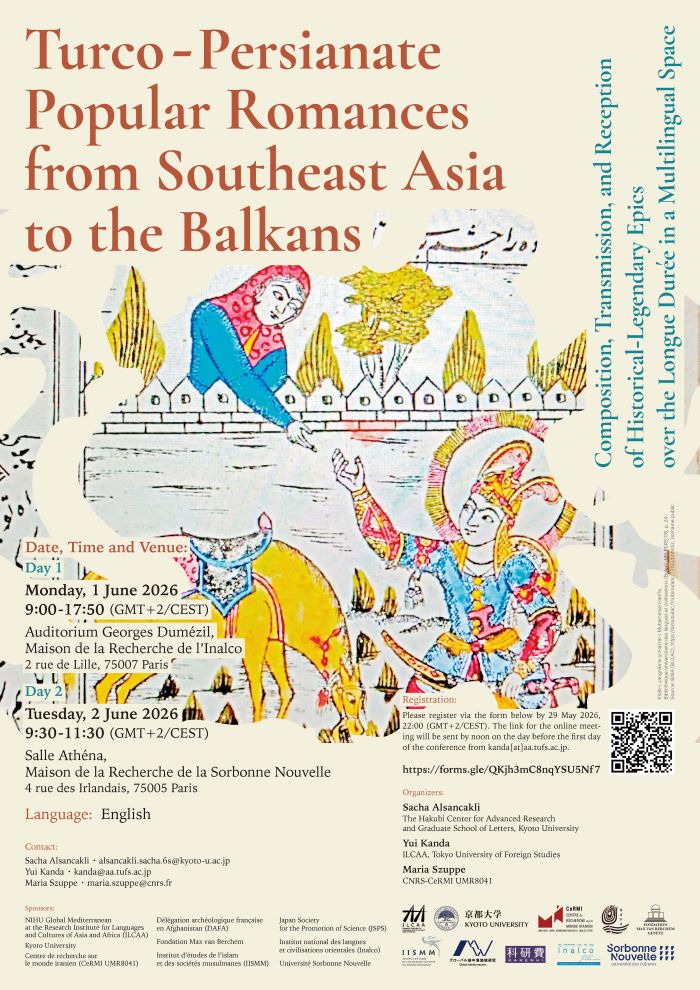
| 日時 | 2026年6月1日(月)9:00–17:50 (GMT+2/CEST) 2026年6月2日(火)9:30–11:45 (GMT+2/CEST) |
|---|---|
| 場所 | (ハイブリッド形式) 6月1日:Auditorium Georges Dumézil, Maison de la Recherche de l’Inalco (2 rue de Lille, 75007 Paris) + オンライン会議室 6月2日:Maison de la Recherche de la Sorbonne Nouvelle (5 rue des Irlandais, 75005 Paris) + オンライン会議室 |
| 参加方法 | 要事前登録 参加申し込みはこちら。 ※2026年5月29日(金)22:00(GMT+2/CEST)までにお申し込みください。 5月31日(日)正午(GMT+2/CEST)までに、Zoom会議室のリンクをお送りいたします。 |
| 参加費 | 無料 |
| 使用言語 | 英語 |
| 共催 | 人間文化研究機構グローバル地中海地域研究アジア・アフリカ言語文化研究所拠点;京都大学;Centre de recherche sur le monde iranien (CeRMI, UMR8041);Délégation archéologique française en Afghanistan (DAFA);Fondation Max van Berchem;Institut d’études de l’islam et des sociétés musulmanes (IISMM);Institut national des langues et civilisations orientales (Inalco);JSPS科研費25K04492;Université Sorbonne Nouvelle |
| 問い合わせ | kanda[at]aa.tufs.ac.jp [at]を@に変えてください。 |
Conceived as a follow-up to the workshop “Amir Hamza and Beyond: Historical Narratives and Romances across the Muslim World”, held in September 2023 at the Research Institute for Languages and Cultures of Asia and Africa (ILCAA) in Tokyo, this international conference explores how communities in the Eastern Islamic world expressed themselves through the composition, transmission, and reception of popular romances. These narratives, centred around historical figures such as Alexander the Two-Horned (d. 323 BC), Ḥamza b. ʿAbd al-Muṭṭalib (d. 625), Muḥammad Ḥanafiyya (d. 701), Abū Muslim (d. 755), and others, often originated in Persian literary traditions. Turkish lore also served as an important source of inspiration, particularly through stories related to the Oghūznāme. These stories formed cohesive narrative cycles and were adapted into localized versions in Arabic, Bengali, Javanese, Malay, Kurdish, Pashto, Persian, Punjabi, Turkish, and Urdu, among other languages, thus extending their influence over the longue durée in the multilingual space stretching from Southeast Asia to the Balkans.
In epics like the Iskandarnāma, Ḥamzanāma, Jangnāma-yi Muḥammad Ḥanafiyya, Abūmuslimnāma, and Oghūznāme, these figures are reimagined as heroes embodying the chivalrous ideals of the Persian javānmardī tradition and are sometimes endowed with supernatural powers. With their transregional presence, seen in shrines across the Turco-Persianate world and in the widespread transmission of localized textual versions, these figures also offer opportunities to examine key aspects of the cultural history of the Eastern Islamic lands, including:
1. The reinvention of early Islamic figures as folk heroes through literature and material culture;
2. The role of orality in the development of this literary tradition and the devotional practices tied to its material culture;
3. The hierarchization of languages and processes of vernacularization in the region;
4. The didactic function of these texts and artifacts in conveying core Islamic values, such as devotion to the ahl al-bayt (family of the Prophet) and the struggle against heresy and injustice.
By addressing these and other questions, the conference aims to provide a comprehensive understanding of the cultural and devotional practices related to the veneration of these popular historical-legendary figures across time and space. Through the examination of texts and artifacts from across the Eastern Islamic world, the project also seeks to bridge institutional divides between Iranian, Turkish, Central Asian, and South Asian studies. Utilizing an interdisciplinary methodology that draws on history, art history, and anthropology, the contributions will notably highlight the role of material culture – such as architecture, objects, and manuscripts – in the analysis of the chosen case studies.
Program
Day 1
Monday, 1 June 2026, 9:00–17:50 (GMT+2/CEST), Auditorium Georges Dumézil, Maison de la Recherche de l’Inalco (2 rue de Lille, 75007 Paris)/Online
| 9:00-9:15 | Welcome Address Jean-François Huchet, President of Inalco Sacha Alsancakli, Yui Kanda, and Maria Szuppe, Organizers |
| 9:15-10:35 | Panel 1: Indo-Persian Religious and Literary Interactions (chair: Satoshi Ogura) Victor Baptiste (EPHE, Paris): An Indo-Persian Tale: The Story of Madhumālatī and Its Metamorphoses Renaud Soler (University of Strasbourg, Strasbourg): The Maghāzī al-Nabī in the Khamsa of the Kashmiri Sufi Poet Ṣarfī (1521-1595): The Multifaceted Prophet as Spiritual Guide and Exemplary Warrior |
| 10:35-10:55 | Coffee Break |
| 10:55-12:15 | Panel 2: Folktales and Legends in Afghanistan (chair: Francis Richard) Shamim Homayun (IASA, The University of Tokyo, Tokyo): The Legend of Salsal: Imagining the Bamiyan Buddhas After the Mongol Conquest Matteo De Chiara (Inalco-CeRMI UMR8041, Paris): Pirs in Pashto Folktales and Legends |
| 12:15-13:30 | Lunch |
| 13:30-15:30 | Panel 3: Classical Texts of Perso-Ottoman Literature (chair: Justine Landau) Maria Szuppe (CNRS-CeRMI UMR8041, Paris): Editorial Practices in the Transmission of Persian Historico-Legendary Epics: “Twin Texts” Production in the Early Modern Period Marc Toutant (CNRS-CETOBaC UMR8032, Paris): Islamic Values and Other Didactic Aspects in Ḥamzavī (d. 1412–1413)’s Ottoman Iskendernāme Michele Bernardini (University of Naples “L’Orientale”, Naples): The Timurnāme of ‘Abdallāh Hātefī (1498) and Its Fame in the Ottoman Empire |
| 15:30-15:50 | Coffee Break |
| 15:50-17:50 | Panel 4: The Stories of Amīr Ḥamza and Muḥammad Ḥanafiyya (chair: Alexandre Papas) Bernard Arps (LIAS, Leiden): The Javanese Amir Hamza in the Sultan of Palembang’s Palace, c. 1800, the Motif of Haste, and Cultural Flows in the Java Sea World Nobuaki Kondo (ILCAA, TUFS, Tokyo): Amīr Ḥamza and Muḥammad Ḥanafiyya: A Comparison Sacha Alsancakli (The Hakubi Center-Graduate School of Letters, Kyoto University, Kyoto): The Role of the Prophet and ʿAlī in the Muḥammad Ḥanafiyya Epics |
| 19:00–22:00 | Dinner |
Day 2
Tuesday, 2 June 2026, 9:30–11:45 (GMT+2/CEST), Maison de la Recherche de la Sorbonne Nouvelle (5 rue des Irlandais, 75005 Paris)/Online
| 9:00-9:30 | Welcome Coffee |
| 9:30-11:30 | Panel 5: The Materiality and Circulation of Turco-Persianate Heroic Figures (chair: Sandra Aube) Yui Kanda (ILCAA, TUFS, Tokyo): Epigraphic Traces of Heroization: ʿAlī and His Descendants on Ilkhanid Lustre Tiles Zeynep Aydoğan (IMS-FORTH, Crete): From Frontier Lore to Historical Authority: The Anatolian Turkish Warrior Epics in the Turco-Persianate World Majid Daneshgar (CSEAS, Kyoto University, Kyoto): Persianate Stories in the Malay-Indonesian World: Reading the Durr al-Majālis |
| 11:30-11:45 | Closing Remarks Sacha Alsancakli, Yui Kanda, and Maria Szuppe, Organizers |
| 12:00-13:00 | Lunch |